
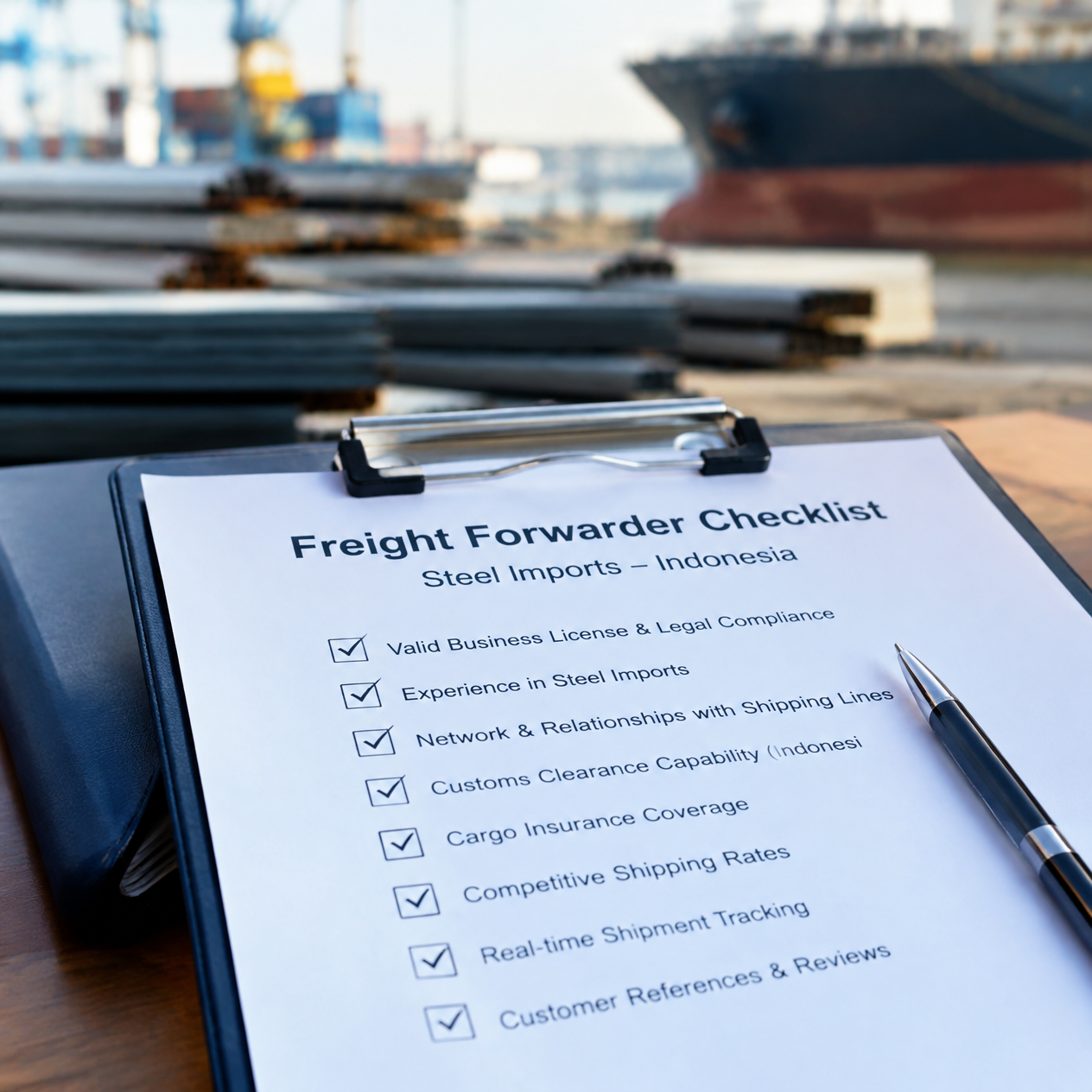
Steel doesn’t forgive sloppy logistics. If you need to choose a freight forwarder for steel imports into Indonesia, the freight rate is the last thing to judge them on.
A coil is 20 tonnes of cargo that rusts, shifts, and costs money for every day it sits on a quay. When I review a failed steel shipment, the freight rate is almost never what went wrong. The forwarder was.
If you’re trying to choose a freight forwarder for steel imports, the ocean freight quote is the least useful number on the table. Here is the checklist I use, and the one I’d hand to any procurement head.
Why the cheapest quote usually costs the most
Ask any Indonesian logistics old-timer and you’ll hear the same story. Importer picks the forwarder with the lowest freight number. Port bill arrives. Jaw drops.
The quote looks clean. Then the extras roll in. Terminal handling. Lashing and dunnage. Trucking surcharges. Chassis fees if your wire rod or cold-rolled is boxed up in containers. And if customs puts a hold on the cargo? Storage and demurrage tick up every single day, whether you like it or not.
A low base rate with vague “local charges” is a loan you repay with interest. I’ve watched a USD 6 per tonne saving turn into a six-figure loss after a nine-day customs hold.
So here’s the real answer to how to choose a freight forwarder. Stop staring at the headline rate. Look at what the whole shipment costs you once it lands, and at how much risk is hiding behind that number.
12-Point Checklist to Choose a Freight Forwarder for Steel Imports
Use this table in your vendor audit. Score each forwarder from 1 to 5 per row.
| # | Checklist Evaluation Area | What to Look For (Key Indicator) | Red Flag to Avoid | Impact on Importer’s Margin |
|---|---|---|---|---|
| 1 | Steel cargo handling expertise | Documented HRC, coil, wire rod, and structural shipments; knowledge of coil eye-to-sky stowage, dunnage, and lashing | “We handle all cargo types” with no steel references | Cuts rust, deformation, and damage claims |
| 2 | Regulatory mastery (Permendag / Pertek / Lartas) | Can explain which of your HS codes need technical approval, SNI, or surveyor reports, before you ask | Treats permits as the importer’s problem | Prevents holds, re-export orders, and penalties |
| 3 | Port and terminal network | Established relationships at Tanjung Priok, Tanjung Perak, and Cigading/Merak; knows which berths suit breakbulk steel | Single-port dependence; no alternate discharge plan | Faster berthing, less congestion cost |
| 4 | Transparent cost breakdown | Line-by-line quote: ocean, THC, lashing, trucking, document fees, surcharges | Lump-sum “all-in” with unexplained “local charges” | Removes surprise invoices |
| 5 | Proactive demurrage mitigation | Written free-time tracking, pre-arrival document checks, escalation process | No demurrage policy; reactive updates only | Protects against the biggest hidden cost |
| 6 | Customs brokerage capability | In-house or tightly integrated PPJK; accurate HS classification and valuation history | Outsourced brokerage with no accountability | Lowers red-lane and audit exposure |
| 7 | Carrier and vessel relationships | Access to bulk and breakbulk operators; flexible space during tight periods | Dependence on a single carrier or NVOCC | Stable space and fairer rates |
| 8 | Cargo insurance and claims support | Marine all-risk cover with wet-damage and rust clauses; claim-filing experience | Basic FPA cover; “insurance is optional” | Recovers losses instead of absorbing them |
| 9 | Documentation accuracy | Pre-checks B/L, packing list, mill certificates, and invoice for consistency | Documents reviewed only after vessel departure | Avoids discrepancy-driven delays |
| 10 | Inland delivery and equipment | Verified heavy-haul trucks, coil carriers, and cranes at your plant gate | Brokering to unknown subcontractors | Prevents last-mile damage and idle production lines |
| 11 | Communication and visibility | Named account manager, milestone updates, escalation contact outside office hours | Updates only when you chase | Gives you time to react to disruptions |
| 12 | Financial stability and references | Verifiable steel-importer references, clean payment record, proper licensing | Refuses to share references; demands large upfront deposits | Reduces the risk of a partner failing mid-shipment |
Treat any forwarder scoring below 3 on rows 2, 4, or 5 as a deal-breaker, whatever the rate.
The points that decide most outcomes
You’ll score all 12. A few deserve extra attention because they cause most of the damage.
Steel-specific expertise (Point 1)
Ask for the last five steel shipments they moved. Ask how they secure coils during a rough crossing. A true specialist answers in detail, and a generalist changes the subject.
Procurement scenario: Your HRC shows up with edge damage and rust spots. The forwarder shrugs: carrier’s problem. Not quite. A real specialist would have spotted the weak stowage and wet-hold risk back at booking.
Regulatory mastery (Point 2)
Indonesia’s steel import rules keep moving. Enforcement isn’t even across product categories, either. Your forwarder should live inside the current Permendag, Pertek, and Lartas requirements every day, not dust them off when something goes wrong.
Try it on the first call. Give them your cargo and HS code, then ask what approvals you need before shipment. A pause, then “let me check and confirm in writing” is fine. Good sign, even. Guessing is not.
Homework first. Read up on Indonesia customs clearance procedures for steel cargo. Pre-arrival to port release, the whole run. Do it before you sit down with any forwarder, and the gaps in their answers jump out.
Cost transparency and demurrage control (Points 4 and 5)
Demand a quote that separates every charge. Then ask these three questions:
- What is the free time at the discharge terminal?
- Who is responsible when customs causes the delay?
- What happens to storage costs if a document is rejected?
A good forwarder has answered these before. A weak one improvises.
Demurrage is a process problem, not bad luck. Good forwarders get documents in early. They watch the free-time clock like a hawk. And they line up trucks before the vessel even berths.
Customs red-lane readiness (Point 6)
Steel shipments get flagged. Valuation questions, HS classification disputes, and origin queries all trigger inspections. You want a forwarder with a record of resolving them quickly.
Ask: “When did you last handle a red-lane shipment, and how long did release take?”
Most of these blow-ups come from the same old habits: rushed paperwork, weak vendor checks, no plan B. Sound familiar? It’s the usual list of common supply chain mistakes that drain operational profits.
How to run the audit
Don’t rely on a sales presentation. Verify.
- Request three steel-importer references and call them. Ask about delays, billing disputes, and responsiveness.
- Issue the same shipment brief to three forwarders. Compare cost structure, not just totals.
- Run a trial shipment before committing annual volume.
- Review the contract’s liability and delay clauses. Know who pays when things go wrong.
- Check licensing and insurance documents yourself.
Quick filter: If a forwarder can’t explain demurrage exposure in plain language, remove them from the shortlist.
Switching forwarders without disrupting production
Already working with someone who scores poorly? Don’t terminate mid-shipment.
Don’t switch everything overnight. Hand the new forwarder a shipment or two, the lower-risk kind, and run them alongside your current one. Keep an eye on transit times, invoice accuracy, and how fast they pick up the phone. Numbers look good? Move volume over bit by bit.
Keep your current forwarder informed enough to hand over documentation cleanly. A messy exit can strand cargo.
What a strong partner looks like
The good ones feel like part of your own procurement team. They raise the red flag before you ask. They tell you the bad news early, even when it’s awkward. And when your cargo is stuck at the port, they fight for it.
They also push back. If your purchase terms create a documentation gap, they tell you. If a supplier’s mill certificate looks inconsistent, they catch it before the vessel sails.
That kind of partner rarely has the cheapest rate on the table. But over a year of shipments, it is nearly always the cheapest relationship.
Print the matrix. Score your shortlist. Then start with the three rows that can hurt you most: regulatory mastery, cost transparency, and demurrage control.
Planning a steel import shipment into Indonesia? Contact the Mahia Ekspres team for a transparent, line-by-line logistics quote.
About the Author: Ilham Sandri Koto