
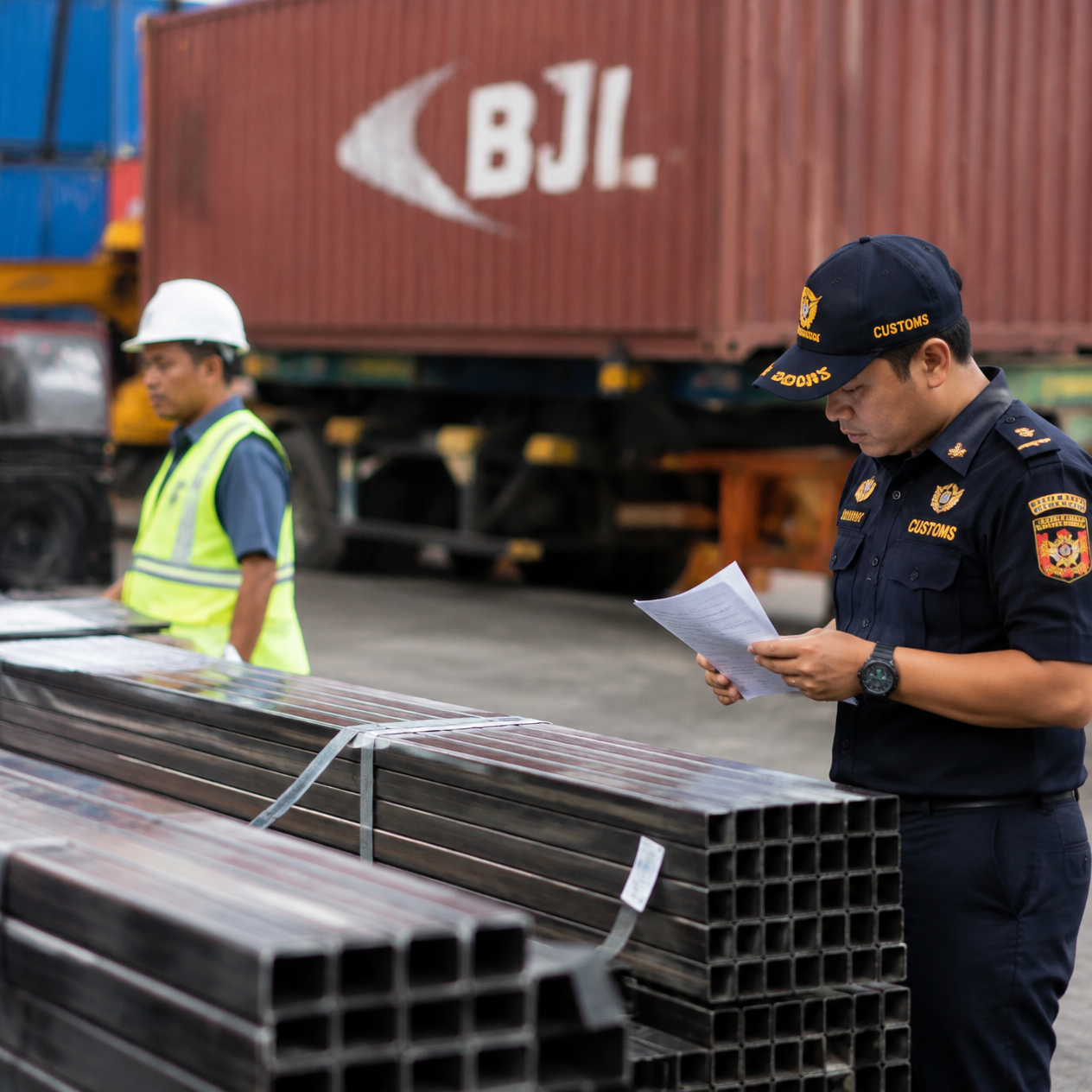
Steel doesn’t wait politely at the berth. Every day a coil sits on a quay in Cigading or Tanjung Priok, storage fees stack up and your production schedule slips.
I’ve watched shipments clear in under two days. I’ve also watched identical cargo sit for three weeks over a 40 kg weight mismatch. The difference is almost never luck. It’s preparation done before the vessel arrives.
This guide walks through the full Indonesia customs clearance steel workflow, in the order it actually happens.
Indonesia Customs Clearance Steel Starts Before the Vessel Arrives
Clearance begins weeks before berthing. By the time the ship’s agent calls, your document set should already be locked.
Three things decide whether your cargo clears smoothly:
- Your import status is clean. Valid NIB, active customs registration in CEISA 4.0, and the right importer identification (API-U or API-P).
- Your HS code is correct. Steel classification drives duty rates, restrictions, and audit attention.
- Your restrictions are cleared. Many steel products carry import conditions that must be satisfied before shipment arrives. Confirm yours by verifying Lartas import restrictions prior to shipment arrival, because the rules differ by HS code and change periodically.
Also check whether your product faces trade remedy duties. Certain flat-rolled and wire products from specific origins have attracted anti-dumping or safeguard measures. Finding that out after filing is an expensive surprise.
The Core Principle: Three Documents, One Truth
Here’s the single most common failure I see.
The Bill of Lading says 25,480 MT. The Packing List says 25,512 MT. The surveyor’s report says 25,495 MT. Someone files the PIB using whichever number was handy.
That mismatch is exactly what the risk engine flags. Experienced customs specialists in Indonesia’s steel ports generally agree on this point: weight and quantity discrepancies between the B/L, Packing List, and Surveyor Report (LS) are among the most common reasons a shipment is pushed into the Red Channel. And once you’re in Red, the physical inspection queue, extra handling, and storage penalties are all your problem.
Pre-filing reconciliation checklist
- B/L, Packing List, Commercial Invoice, and LS agree on gross and net weight, within a documented tolerance.
- Coil numbers, heat numbers, and bundle counts match line by line.
- Description of goods uses the same wording and HS code throughout.
- Origin on the invoice matches the Certificate of Origin.
Reconcile first. File second.
Step-by-Step: The Clearance Workflow
1. Pre-Arrival Manifest (BC 1.1)
The carrier or its agent submits the inward manifest (BC 1.1) before the vessel arrives. You don’t file this, but you must make sure your cargo details are consistent with it. If your B/L data doesn’t match the manifest entry, correcting it later takes time you don’t have.
2. PIB Electronic Filing in CEISA 4.0
The PIB (Pemberitahuan Impor Barang) is your import declaration, filed through CEISA 4.0. Most importers delegate this to a PPJK (customs broker).
You can generally lodge the PIB before the vessel berths, and I recommend you do. Early filing means the system has already assigned a channel by the time cargo is discharged. Late filing means cargo waits for you.
If you’re claiming duty reductions, attach proper origin evidence. Planning for applying Form E or Form D preferential Certificates of Origin should happen at the shipping stage, since a COO issued late or with errors can cost you the preferential rate.
3. Duty and Tax Payment (Billing Code)
Once the PIB is validated, the system issues a billing code. You pay import duty (BM), VAT (PPN), and income tax on imports (PPh Pasal 22) through the designated e-payment channels.
Rates vary by HS code, origin, and your importer status, so confirm them with your broker for each shipment rather than assuming last quarter’s numbers. Payment confirmation flows back electronically.
Short statement: no payment, no release.
4. Channel Assignment: Green, Yellow, or Red
The system assigns a channel based on risk profile:
- Green: Released without document or physical check, subject to post-clearance audit.
- Yellow: Document examination only.
- Red: Document examination plus physical inspection.
Importers with a strong compliance record and registered facilities (such as those with MITA or AEO-type status) usually see more favorable channel treatment. First-time steel importers? Expect scrutiny.
5. Physical Inspection and Lab Testing
If you land in Red, customs officers inspect the cargo at the terminal. For steel, that typically means verifying coil or bundle counts, checking markings against documents, and sometimes drawing samples for lab testing to confirm material grade or classification.
On breakbulk steel, inspection is physically awkward. Coils are stacked, lashed, and heavy. Coordinate with your terminal and broker so inspection slots, equipment, and labor are ready when the officer is.
6. SPPB Release Approval
The SPPB (Surat Persetujuan Pengeluaran Barang) is the release approval. It’s the document the terminal gate actually wants to see. Without it, your trucks don’t leave.
7. Delivery Order and Gate-Out
With SPPB issued, you collect the shipping line’s Delivery Order (DO), settle terminal charges, book trucks, and move cargo out. Do the DO paperwork in parallel with customs processing, not after it. I’ve seen perfectly cleared cargo sit idle simply because nobody asked the line for the DO.
The Clearance Workflow Matrix
| Customs Clearance Stage | Required Documentation Set | Responsible Party | Typical Processing Lead Time | High-Risk Delay Trigger / Demurrage Bottleneck |
|---|---|---|---|---|
| Pre-Arrival Manifest (BC 1.1) | B/L data, vessel particulars, cargo manifest | Carrier / Shipping Agent | Submitted before vessel arrival | B/L details inconsistent with later PIB data |
| PIB Electronic Filing (CEISA 4.0) | Commercial Invoice, Packing List, B/L, LS (where required), COO, import approvals as applicable | Importer / Forwarder (PPJK) | Hours to 1 day if documents are ready | Weight or quantity mismatch across B/L, PL, and LS; wrong HS code |
| Duty & Tax Payment (Billing Code) | Billing code, payment proof | Importer / Forwarder | Same day, bank-dependent | Insufficient funds, wrong tax status, unexpected trade remedy duty |
| Channel Assignment (Green / Yellow / Red) | Automated risk profiling; no new documents | Customs System / Officer | Minutes to hours | Weak compliance history, high-risk HS code, valuation anomalies |
| Physical Inspection & Lab Testing | Full original document set, access to cargo, sampling support | Customs Officer / Importer / Terminal | 1 to 5+ days; longer if lab testing is needed | Stacked coils, unclear markings, lab turnaround, equipment unavailable |
| SPPB Release Approval | Cleared PIB, payment confirmation, inspection result | Customs Officer | Hours after all conditions are met | Open queries unanswered, unresolved notification |
| Delivery Order & Gate-Out | SPPB, DO, terminal charge receipts, truck manifests | Importer / Forwarder / Shipping Line | 0.5 to 2 days | DO delayed by line, truck shortage, terminal cut-off times |
Lead times are indicative. Port, season, cargo type, and channel all move them.
Port-by-Port Reality
Each port has its own rhythm.
- Cigading and Merak: Heavily steel-oriented, which helps, since officers and terminals see coils daily. But berth congestion can still stretch waiting time.
- Tanjung Priok: High volume and high activity. Truck slots and terminal gate hours become the bottleneck, not customs.
- Surabaya and Semarang: Strong industrial hinterlands, but inspection resources and equipment availability can vary. Confirm before arrival.
Ask your broker which terminal handles your cargo and what their free-time window is. Free time is shorter than most first-time importers assume.
Scenarios That Cost Real Money
Scenario A: The 17 MT gap. An HRC shipment arrives with a B/L weight of 24,800 MT and an LS figure of 24,783 MT. The PIB used the B/L number. The system flags a discrepancy, the cargo goes Red, and inspection adds four days. At typical storage rates, that’s a bill nobody budgeted for.
Scenario B: The late COO. A trader ships wire rod expecting preferential duty. The Certificate of Origin arrives after the vessel does. Result: full duty, or a delayed release while documents are resolved.
Scenario C: The ignored query. Customs raises a notification on the PIB. The broker’s inbox is unmonitored over a weekend. Cargo sits until Monday.
None of these are exotic. All of them are preventable.
Tactical Moves That Shorten Dwell Time
- File the PIB before berthing, not after discharge.
- Run a three-way document reconciliation at least two days before ETA.
- Pre-book trucks and the DO while customs processes your declaration.
- Monitor CEISA notifications daily, including weekends when a vessel is in port.
- Document your tolerance policy for steel weights so officers see a consistent, explainable basis.
- Keep mill test certificates and technical data on hand. If lab testing is triggered, speed matters.
- Choose a broker with real experience at your specific port. A general-purpose PPJK is not the same as one who knows the Cigading gate.
What I’d Tell a First-Time Importer
Treat clearance like a project, not an afterthought. Set a pre-arrival checklist, assign one owner for each document, and agree on a communication line with your broker before the vessel sails.
The importers I see clearing fastest aren’t the ones with the best connections. They’re the ones with the cleanest paperwork.
Regulations, rates, and procedures in Indonesian customs change, so confirm current requirements for your specific HS code and port with your licensed customs broker before filing.
About the Author: Ilham Sandri Koto