If you’re a first-time steel importer in Indonesia, the permit sequence matters more than the price per ton.
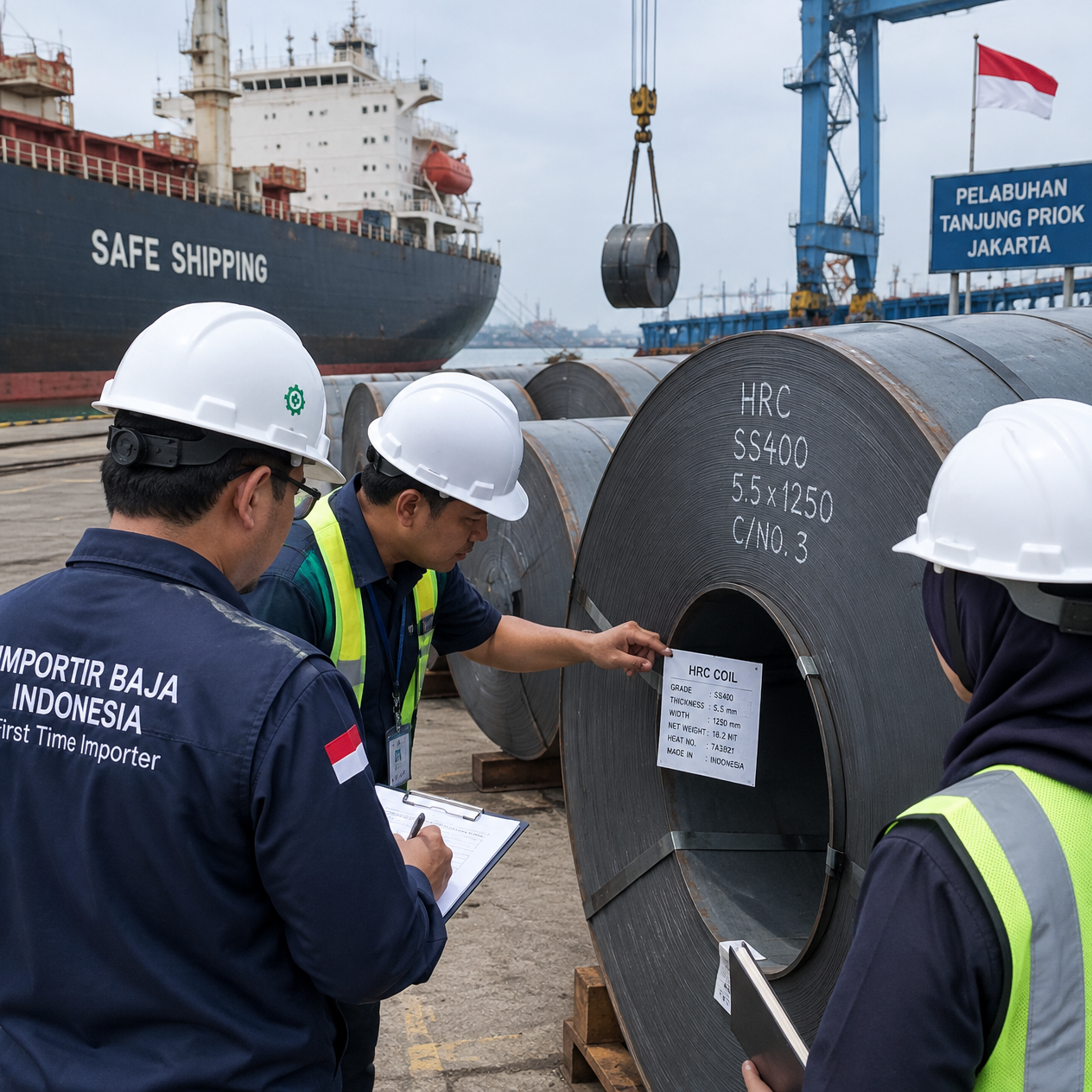
I have stood on enough port docks to know how a bad first import looks. A coil sits under a tarp. The container clock is ticking. The importer is on the phone, pale, asking why nobody told him about the permit.
Steel is not like importing office chairs. It is a controlled commodity.
The good news: the process is a sequence. Follow it in order, and your first shipment can land clean. This is that sequence.
Why Every First-Time Steel Importer in Indonesia Faces Extra Scrutiny
Indonesia protects its domestic steel industry. Import rules for steel sit in a separate sectoral framework, and Permendag No. 22/2025 covers selected industrial products such as steel, ceramics, tires, and downstream plastic products. That sits under the umbrella of the general import policy, Permendag 16/2025.
The rules keep moving. Permendag 18/2026 landed on 4 June 2026, and it’s stricter. Data has to line up across systems now, realization reports matter more, and permit documents get checked harder. So don’t treat this guide as the law. It’s a map. Before you sign anything, confirm your HS code and the current rules on the INSW portal, or ask a licensed customs broker. Ten minutes of checking beats ten weeks of regret.
The Mistake I See Most Often
Ask any Indonesian customs broker what sinks first-timers. You will hear the same story.
The buyer negotiates a great price on HRC. He pays a deposit. The mill ships. Then he applies for his technical recommendation and import approval.
Too late.
Ask brokers at Tanjung Priok, Tanjung Perak, or Belawan, and they’ll tell you the same story. Coils parked at a foreign port, going nowhere. Or worse, coils that reach Indonesia with no valid approval, and Customs says re-export. Same mistake every time. Both outcomes are expensive. Permits first, purchase order second. That one rule saves more money than any freight negotiation.
The Roadmap Matrix
Here is the whole journey on one page. Timelines are typical ranges. Your timing might be quicker. It might be slower. A lot depends on how complete your files are and how busy the agencies happen to be.
| Roadmap Stage | Required Documentation | Responsible Agency / Party | Estimated Timeline | Beginner Pitfall to Avoid |
|---|---|---|---|---|
| Stage 1: Corporate Legal Setup (NIB & API) | Company deed (Akta), NPWP, NIB via OSS, API-U or API-P registration, KBLI codes matching steel trade or production | Ministry of Investment (OSS), Notary, Ministry of Law | 1–2 weeks | Wrong KBLI code. A trading company registered for the wrong activity cannot apply for the right permit |
| Stage 2: Technical & Import Permits (Pertek & PI) | Pertek application, company profile, production or usage plan, product specs, HS code, proforma invoice | Ministry of Industry (Pertek), Ministry of Trade (PI) | 2–6 weeks, often longer for first applications | Applying with a vague quantity or the wrong HS code. The PI locks in type, volume, and port |
| Stage 3: Contracting & Cargo Shipping | Sales contract, commercial invoice, packing list, mill test certificates, bill of lading, insurance | You, the overseas mill or trader, freight forwarder, shipping line | 3–8 weeks including transit | Contract specs that differ from the Pertek and PI. Mismatches follow the cargo all the way to customs |
| Stage 4: Pre-Shipment Surveyor Verification (LS) | Pertek, PI, invoice, packing list, mill certificates, inspection access | Government-appointed surveyor (Laporan Surveyor) at origin | 1–2 weeks | Inspecting after loading. Verification belongs before the vessel sails |
| Stage 5: Customs Clearance & Port Release | PIB (import declaration), LS, PI, B/L, invoice, packing list, duty and tax payment proof | Customs broker (PPJK), DJBC Customs, terminal operator | 2–5 days if clean | Free time running out at the terminal because paperwork is incomplete |
Print this. Tape it above your desk.
Stage 1: Build the Right Legal Shell
Your NIB (Nomor Induk Berusaha) is your business identity. It also functions as your importer registration.
Know which one you need:
- API-U (Angka Pengenal Importir Umum): for trading companies that import to resell.
- API-P (Angka Pengenal Importir Produsen): for manufacturers importing for their own production.
The regulation defines both as importer registrations attached to the NIB: API-U is the registration of an NIB holder as a general importer, while API-P is the same for a producer importer.
Scenario: A pipe factory in Cikarang imports HRC to feed its ERW mill. That is an API-P case. A distributor in Surabaya buying coils for resale needs API-U. Choose wrong, and your permit application stalls.
Stage 2: Pertek and PI, the Real Gatekeepers
Pertek (Pertimbangan Teknis) comes from the Ministry of Industry. It tells the government your volume and specification make sense for your business.
PI (Persetujuan Impor) comes from the Ministry of Trade. It states what you may import, how much, through which port, and for how long.
Think of Pertek as the technical question and PI as the final answer.
Quick checks before you apply
- Confirm your exact HS code against the current Lartas list on INSW.
- Check whether your steel product needs mandatory SNI.
- Ask whether trade remedies (anti-dumping or safeguard duties) apply to your origin country.
- Match product description, grade, and quantity across every document.
Scenario: You order 500 tons of cold-rolled coil but your PI says 300. The extra 200 tons has no legal basis to enter. Apply for what you will actually buy, with sensible room for tolerance.
Stage 3: Contract Smart, Ship Carefully
Now you can buy.
Write the permit numbers into the contract. Require the seller to confirm shipment specs match your Pertek and PI. Insist on complete mill test certificates, because the surveyor will ask for them.
Then pick your logistics partner. Don’t cheap out here. Steel is its own world. A forwarder who’s done it before knows lashing, dunnage, draft surveys, and the odd habits of each port. Still comparing? This guide to choosing an experienced freight forwarder for steel imports walks through a 12-point checklist.
Next question: how will the steel actually travel? Heavy coils often go breakbulk. Sometimes they go in containers. It comes down to coil size and what the port can handle, so ask your forwarder early. Ask early about discharge equipment at your destination terminal.
Stage 4: The Surveyor Check (LS)
The Laporan Surveyor (LS) is verification by an appointed surveyor, usually at the loading port. It confirms that what is shipping matches what your permits allow.
No LS, no clearance. It is that simple.
Here’s where beginners get burned. Under Permendag 18/2026, the LS and your import declaration (PIB) get cross-checked against each other. The classic slip? The permit number on the surveyor’s report doesn’t match the one on the PIB. One wrong digit. That’s all it takes to freeze a container.
Check every number yourself. Then check again.
LS checklist for your first shipment
- PI number identical across LS, invoice, and PIB
- Quantity within permit limit
- HS code consistent everywhere
- Port of discharge matches PI
Stage 5: Customs Clearance
Your customs broker (PPJK) files the PIB through the customs system. You pay import duty, VAT, and income tax prepayment. Customs may then assign a green lane, yellow lane, or red lane (physical inspection).
Steel often draws physical checks. Plan for it.
Where the real money is lost is time. Terminal free days run out fast, and demurrage starts counting. Your broker needs your complete documents before the vessel arrives, not after. For tactics that keep cargo moving, read this practical guide on preventing costly container demurrage fees at Indonesian ports.
One more point on timing. Permits have validity windows. Permendag 18/2026 adds some flexibility: for certain goods needing an LS, where technical verification was completed within the permit’s validity and the goods have arrived at the destination port, the LS may be issued after the permit expires without a new inspection. Do not count on that as a plan, though. Treat it as a safety net.
Landed Cost: Budget Beyond the Mill Price
New importers often compare FOB prices and forget the rest. Build your cost sheet with these lines:
- Ocean freight and surcharges
- Marine cargo insurance
- Surveyor fees
- Import duty, VAT, and income tax prepayment
- Terminal handling, trucking, and lashing/unlashing
- Customs broker fees
- Possible demurrage reserve
Add a contingency of a few percent. Your first shipment will teach you things.
Your First-Shipment Sequence
- Register NIB with the correct KBLI and API type.
- Confirm HS code and applicable rules on INSW.
- Secure Pertek, then PI.
- Negotiate the contract with permit numbers written in.
- Appoint your forwarder and customs broker.
- Complete the LS before loading is finalized.
- Send final documents to your broker ahead of arrival.
- Clear customs, then arrange trucking to your yard.
A Word Before You Start
After import approval, you also carry reporting duties. Permendag 18/2026 emphasizes import realization reports, and sanctions for non-compliance escalate from warnings to suspension of your import permit. File on time.
Your first shipment is the hardest. It is also the one that builds your track record with agencies, surveyors, and brokers. Do it cleanly, and your second and third will feel routine.
Start with the paperwork. Let the steel follow.
This article is for general guidance. Indonesian import rules change often. Verify current requirements with the Ministry of Trade, Ministry of Industry, INSW, and a licensed customs broker before purchasing.
About the Author: Ilham Sandri Koto