
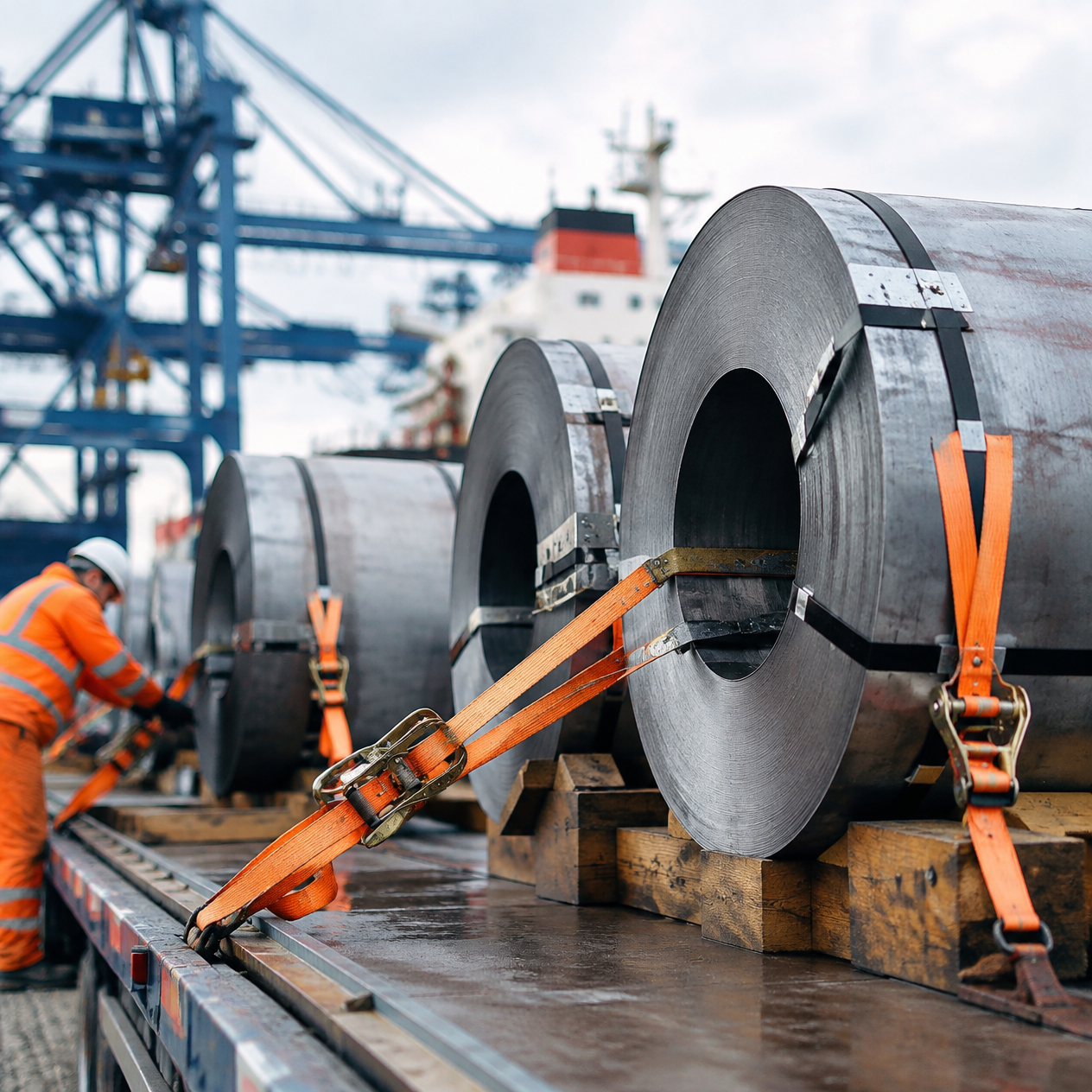
Good freight forwarding best practices for steel start before the vessel sails. Shipments rarely fail at sea. They fail in the paperwork before sailing, or the trucking after discharge.
I have stood on enough Tanjung Priok quaysides at 5 a.m. to know how steel shipments fail. Rarely at sea. Almost always in the paperwork before sailing, or the trucking after discharge.
This is the steel importer checklist I wish every procurement head had on their desk. It covers the full chain of steel import operations, from supplier qualification to the gate of your factory.
Why steel punishes sloppy workflows
Steel is heavy. It rusts. It scrapes up everything it touches, and regulators keep a close eye on it. So one weak link, a wrong HS code or a coil that shifts in the hold, and you’re looking at lost weeks and a demurrage bill that stings.
The best freight forwarding best practices for steel really boil down to a habit. Check early. Check again. And put a real name next to every task.
Phase 1: Pre-shipment and supplier qualification
Start before the purchase order.
Qualify the mill, not just the trader. Ask for mill test certificates (MTC) with heat numbers on them. A generic “high quality” letter doesn’t count. Can’t trace a coil back to its heat? Walk away.
Lock the Incoterm deliberately. FOB gives you control over the freight and vessel choice. CFR or CIF feels easier, sure. But then the seller decides how your coils get loaded and lashed, and sellers chase the cheapest option, not the safest one for your cargo.
- Confirm HS classification with your forwarder or customs broker before signing. Steel alloys and coating variations shift duty and permit requirements.
- Specify packaging in the contract: edge protectors, steel strapping count, waterproof wrapping, coil weight and dimension tolerances.
- Arrange pre-shipment inspection at the loading port for high-value or first-time suppliers.
New to all this? Start with a roadmap for first-time steel importers in Indonesia before you book that first container or breakbulk parcel.
Phase 2: Permit and document audit
Documents kill more shipments than weather does.
Depending on product category and current regulation, Indonesian steel imports may require technical approval (Pertek) from the Ministry of Industry and an import approval (PI) from the Ministry of Trade. SNI conformity can also apply. The rules have shifted more than once lately. So check what applies to your HS code before every contract. Every single one. Last year’s file won’t save you.
Audit the full set before the vessel sails:
- Commercial invoice, packing list, and bill of lading must match on description, quantity, weight, and consignee.
- Certificate of Origin (COO) must be valid if you plan to claim preferential duty under an FTA.
- Mill certificates must reference the actual heat or coil numbers shipped.
- Permit validity must cover the arrival date, not the booking date.
Trade scenario: An importer held a valid approval for 2,000 MT of HRC. Then loading slipped. The vessel turned up three weeks late, and by then the approval had expired. The steel sat on the quay, storage meter running, while the team begged for an extension.
Have someone who didn’t prepare the documents audit them before sailing. Fresh eyes catch most of these mistakes.
Phase 3: Ocean booking and cargo securing
This is where steel gets damaged. Quietly, and often invisibly until your factory unloads.
Choose the shipping mode honestly. Coils, wire rods, small parcels? Usually containers. Heavy plate, structural sections, big tonnages? Breakbulk or bulk. Each demands a different lashing and dunnage plan.
Insist on a written securing plan. For coils, think timber cradles or saddles, the right orientation (eye-to-sky or eye-to-wall), chocking, and strapping rated for the tension. For breakbulk, dunnage layout and tomb-stowing go into the stowage plan up front. Not after something moves.
- Appoint a loading supervisor or surveyor at origin to photograph stowage and lashing.
- Specify tarpaulin and ventilation requirements for rust-sensitive cold-rolled products.
- Insure all-risk, not minimal cover. Wet damage and shifting claims are routine in steel.
- Negotiate free time and laytime at discharge. Port congestion is a cost line, not an excuse.
Ask your forwarder who owns lashing at each stage. Vague answer? Then the risk is sitting with you.
Phase 4: Port customs clearance
Clearance is a workflow, not an event.
Customs declarations in Indonesia go through CEISA, and permit data flows in via INSW, the national single window. Here’s what matters: weights and descriptions have to match everywhere. Every system, every document. One mismatch and your declaration can land in the red lane for a physical check.
Pre-lodge where you can. File the import declaration (PIB) as early as the rules allow, with duty and tax figures already reconciled.
Prepare for inspection. A red lane means opening up steel coils, and that takes equipment, labor, and time. Line up the stripping and re-stuffing crews beforehand. Haggling at the terminal gate gets expensive fast.
Track terminal deadlines. Storage tariffs at major ports escalate quickly after the initial free period. Know the day your clock starts.
Choosing a partner with real port-side experience matters here. Don’t just compare quotes. Run a checklist for evaluating experienced freight forwarders for steel imports.
Phase 5: Inland transport and final delivery
Customs release is not the finish line. It is the halfway mark.
Ask anyone who trucks steel out of Indonesian ports and you’ll hear the same thing: cargo is most exposed after clearance. Axle load limits get overlooked. Coils get lashed sloppily on the truck. Then come weighbridge stops, fines, and loads shifting on long hauls. A lot of damage claims that surface at the factory? They started on the road, not in the vessel hold.
That reflects daily reality on routes out of Priok, Cigading, and Tanjung Perak.
- Match truck configuration to cargo weight. Check axle weight limits and the rules against over-dimension, overloaded vehicles before you dispatch.
- Re-lash for road conditions. Sea-fastening is not road-fastening.
- Confirm factory unloading capacity: crane tonnage, forklift attachments, and yard load-bearing surfaces.
- Plan routing and timing around permitted travel windows for heavy cargo.
The operational checklist matrix
Use this table as your working document. Assign names, not departments.
| Operational Phase | Critical Action Item | Verification Document / Key Metric | Responsible Party | High-Risk Operational Bottleneck |
|---|---|---|---|---|
| Phase 1: Pre-Shipment & Supplier Qualification | Qualify mill, confirm Incoterm, fix packaging specs | MTC with heat numbers; signed PO with packaging clauses | Procurement / Supplier | Trader supplying non-traceable material |
| Phase 1 | Confirm HS code and duty exposure | Broker’s written HS classification | Customs broker / Importer | Misclassification triggering reassessment |
| Phase 2: Permit & Document Audit (Pertek/PI/COO) | Verify Pertek/PI/SNI applicability and validity | Permit validity vs. vessel ETA | Importer / Compliance | Permit expiring before arrival |
| Phase 2 | Cross-check invoice, packing list, B/L, COO | Zero mismatches in weight, description, consignee | Forwarder / Importer | Document discrepancies delaying release or LC payment |
| Phase 3: Ocean Booking & Cargo Securing (Lashing/Dunnage) | Approve written lashing and dunnage plan | Stowage plan; loading surveyor photo report | Forwarder / Origin surveyor | Coil shift or crushing in transit |
| Phase 3 | Secure cargo insurance and negotiate free time | Insurance certificate; agreed laytime/free days | Importer / Forwarder | Underinsurance; demurrage exposure |
| Phase 4: Port Customs Clearance (CEISA/INSW) | Pre-lodge PIB, reconcile duty and tax | PIB data matches all documents; payment confirmation | Customs broker | Red lane inspection from data mismatches |
| Phase 4 | Schedule discharge, inspection, and storage clock | Terminal free-period deadline tracker | Forwarder / Terminal agent | Storage charges escalating after free period |
| Phase 5: Inland Transport & Final Delivery | Match truck, axle load, and lashing to cargo | Weighbridge ticket; trucking lashing checklist | Trucking operator / Forwarder | Overload stops, load shift, cargo damage |
| Phase 5 | Confirm factory unloading readiness | Crane/forklift capacity; receiving inspection report | Factory logistics / Warehouse | Idle trucks and detention at the gate |
Freight forwarding best practices for steel: common failure points
Treating the forwarder as a booking agent. For steel, that’s not enough. You want a partner who flags lashing, permit, and routing risks before you ask.
Ignoring outturn surveys. Get a surveyor on site at discharge. If something’s damaged, you need proof before the cargo leaves the terminal. Without it, your claim is thin.
Splitting responsibility. Origin, ocean, customs, trucking: four parties who never talk means nobody owns the gaps. One accountable coordinator beats four brilliant specialists working in silos.
Build your workflow around handoffs
Most steel losses happen at handoffs. Supplier to forwarder. Forwarder to terminal. Terminal to trucker. Trucker to factory.
Map each handoff. Decide what document or photo proves each handoff went right. Then don’t budge on it.
Run this checklist on your next shipment. Mark where your process leaks. Fix the costliest leak first.
Editor’s note: Pertek, PI, SNI, and customs procedures change often. Before you publish, get your compliance team to confirm what’s current and add a “last reviewed” date.
About the Author: Ilham Sandri Koto