
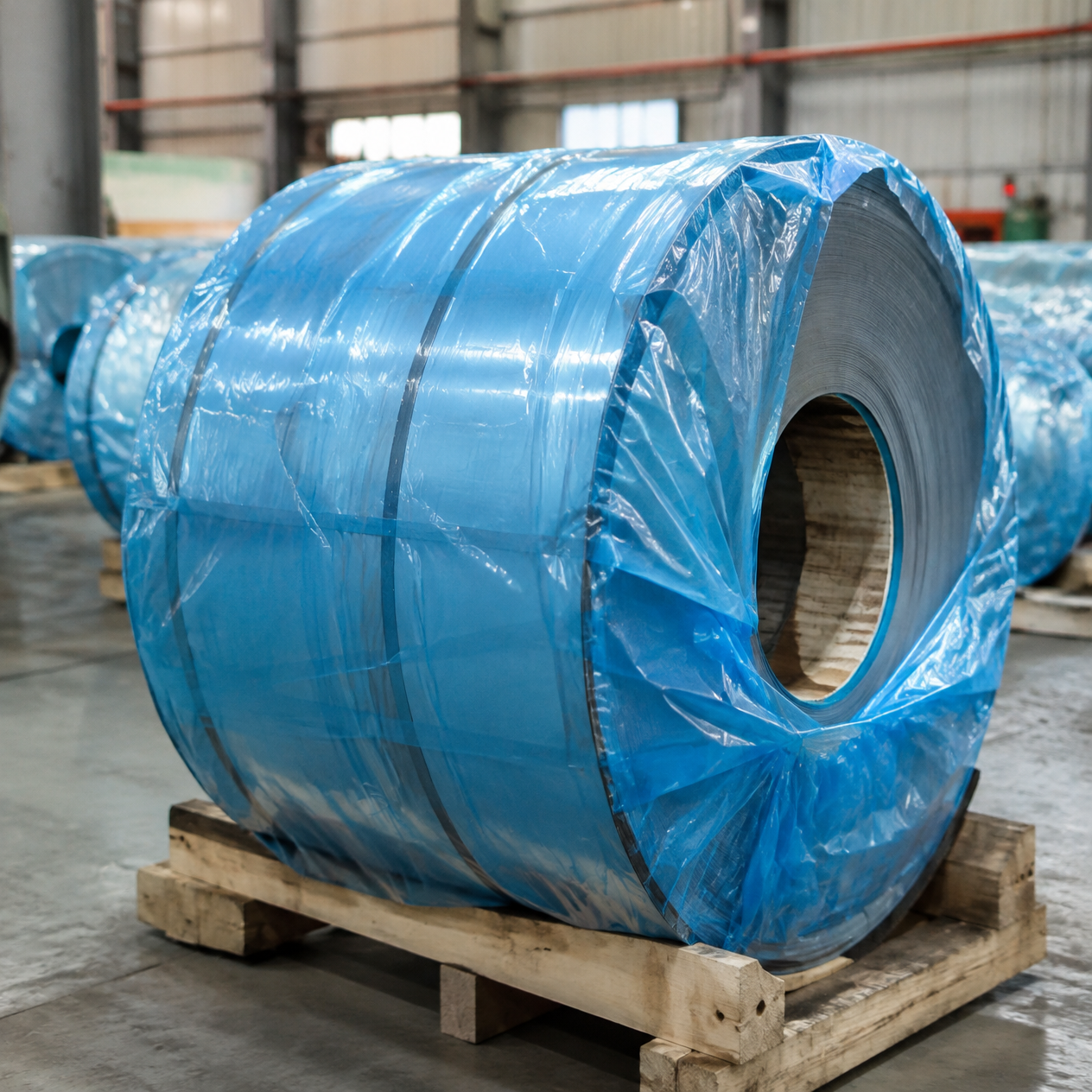
Steel doesn’t rust because it’s old or cheap. It rusts because water found it. If you want to avoid rust in steel coil shipping, you have to stop that first.
Years of walking stuffing yards in Tanjung Priok, Belawan, and Tanjung Perak. Years of standing in receiving bays while coils rolled off trucks looking like they’d been dunked in tea. You start to see a pattern.
Almost every rust claim I’ve looked at comes down to three things. Wrap that was thin or torn. Moisture stuck inside the box. Or somebody handled the coil badly and gave water a way in.
This guide covers all three. If you want to avoid rust in steel coil shipping, start here.
Why You Must Avoid Rust in Steel Coil Shipping
Steel wants to rust. It always has. Add a little moisture. Some oxygen. The iron starts turning into iron oxide. Slow at first, then fast. Throw in salt from the sea air and it gets faster. A lot faster.
The real culprit during ocean freight is sweat, not rain.
Cargo sweat forms when warm, humid air meets a cold steel surface. Coils loaded in a cool northern port and discharged into the Indonesian tropics are the classic case. The steel stays cold for hours. The air around it? Easily 80% relative humidity, sometimes more. Moisture beads up on the cold metal. That’s where the damage starts.
Container sweat is the cousin. Sun beats on the cargo all day, and the cargo sweats out its moisture. Then comes the night. The container wall cools, droplets form up on the ceiling, and down they come. Right onto your coils. Surveyors call it “container rain.” We see it on reports all the time.
Industry-consensus observation: Ask any marine surveyor working Indonesian ports. They’ve seen it a hundred times. One small tear in the VCI wrap. An unsealed seam. That’s all it takes. Within 48 hours of discharge, cold-rolled coils can be flashing rust. What set it off? The dew-point swing between the vessel hold and the open quay. Nobody was watching it.
Know Your Coil: Risk Varies by Grade
Not every coil needs the same armor. Raw hot-rolled? It shrugs off a bit of surface oxidation. Put the same marks on a cold-rolled sheet headed for appliance manufacturing and you’ve got a rejected lot.
Match protection to the product and its end use. Overpacking wastes money. Underpacking costs far more.
| Steel Coil Grade / Surface Finish | Primary Moisture / Damage Risk | Mandatory Packaging Layers | Desiccant & Humidity Target | Critical Handling Equipment |
|---|---|---|---|---|
| Cold-Rolled Steel (CRC) | Flash rust from condensation; fingerprint staining; edge corrosion | VCI paper inner wrap, HDPE or polyethylene film, waterproof kraft, outer steel jacket with edge protectors | Desiccant bags sized to internal volume; hold below 40% RH inside the wrap | Padded slings or C-hook with protective liners; never bare chain |
| Hot-Rolled Pickled & Oiled (HRPO) | Oil film breakdown; rust bloom where oil thins at the edges | Oiled surface plus VCI film, waterproof paper, steel strapping with edge guards | Desiccant in the wrap; keep container RH below 50% | C-hook or coil tongs; avoid oil contamination of slings |
| Galvanized / Galvalume Coil | White rust (zinc corrosion) from trapped moisture between wraps; chemical passivation damage | Interleaved VCI-compatible paper, moisture-barrier film, hard-sealed outer wrap | Desiccant plus ventilated storage; target below 50% RH and zero standing water | Padded C-hook; soft contact only to protect the coating |
| Raw Hot-Rolled Coil (HRC) | Surface rust, scale lifting, edge dents from rough handling | Waterproof paper or HDPE wrap, steel strapping, edge protection | Lower sensitivity; keep dry, avoid open-air storage in rain | C-hook or coil lifting beam; padded slings where cosmetics matter |
Read that table before you write your purchase specification. If you’re buying CRC and the supplier quotes the same packaging as for raw HRC, push back.
Step 1: Pre-Shipment Packaging
This is where the battle is won. By the time a coil reaches the port, its protection is either good or it isn’t.
Check the layers in order, from the inside out:
- VCI paper or film against the steel. Vapor Corrosion Inhibitor chemistry sends off molecules that land on the metal and build a barrier too small to see. Here’s the catch. It only works in an enclosed space. Torn wrap, no protection.
- A moisture-barrier layer. HDPE film or polyethylene-laminated kraft keeps outside humidity from seeping through.
- Waterproof outer paper. It takes the abrasion and the rain.
- A steel jacket with edge protectors. It stops dents, and buyers underrate that. One dented edge, and water has a way in.
Seal the eye of the coil. The bore is the most overlooked entry point. I’ve opened coils where the outside looked perfect and the inner eye was soaked.
Don’t pack a wet coil. Sounds obvious. Still happens. Wrap steel that’s damp, or still warm from processing, and you’ve sealed the moisture in. VCI film can’t fix that. Let the coil come down to ambient temperature, dry it, then wrap.
Step 2: Container Moisture Control for Steel Coil Shipping
Your coil can arrive in a good wrap and still get ruined by the box it rides in.
Walk every container before you load. Start with the light test. Doors shut, eyes open, look for daylight. A pinhole is a leak. Then check the floor for damp patches, old cargo residue, rust flakes. Then smell it. Musty? That’s trapped moisture.
Container Pre-Loading Checklist
- Doors seal tightly, no light leaks
- Floor dry, clean, and free of residue
- No roof dents or open seams
- Desiccant units hung or placed per container volume
- Dunnage dry and below 18% moisture content
Dunnage deserves its own warning. Wet timber holds way more water than you’d think, and you’re the one hauling it into the box. Stick with kiln-dried or properly seasoned wood. Keep it covered right up until loading.
Desiccants have limits. A desiccant bag soaks up a fixed amount, then it’s finished. So size it to the container volume and the length of the voyage. Indonesia-bound shipments crossing multiple climate zones need more capacity than a short coastal trip.
Blocking and bracing is a skill of its own. Our guide on best practices for lashing, dunnage, and securing steel coils in containers walks through it. Here’s the short version: a coil that slides around in transit shreds its own wrap. And torn wrap means rust.
Step 3: Choosing the Right Handling Equipment
Water finds damage. Damage often comes from a crane hook.
I once watched a stevedore team lift a CRC coil using plain chain slings because the padded ones were “somewhere else.” Within an hour the coil showed crush marks on the outer wraps, and the VCI layer underneath was scored. That shipment was downgraded before it ever left the yard.
Match the equipment to the load:
- C-hooks are the standard for coils with a horizontal eye. They cradle the coil through the bore without touching the outer wraps.
- Padded slings or coil lifting beams protect cosmetic surfaces when you can’t use a C-hook.
- Forklift with a coil ram or protected arm works for yard moves, but only with a clean, padded contact surface.
Rules that don’t bend:
- Never lift a coil with bare chain or wire rope on the outer surface.
- Never drop, slide, or drag a coil, even on dunnage.
- Never stack coils beyond the stated crush limit of the lowest unit.
- Keep operators trained. A lazy crane driver does more damage than a rough ocean.
Step 4: Port Discharge and Receiving Inspection
Discharge is where it gets risky. One moment the coil sits in a controlled box. The next it’s on an open quay, and that temperature gap can set off condensation fast. Minutes.
Don’t let coils sit in the open. Move them to covered storage quickly. Hot, humid quay. Cold coil, straight out of the container. Yes, it’s going to sweat. Let it sit and acclimate before you touch that wrap. And rain? Leave the wrap on until it’s dry.
Inspect on arrival, and document everything:
- Photograph the outer wrap, the eye, and the edges before opening anything.
- Check for torn wrap, water stains, dents, and strapping damage.
- Record humidity or condition readings in the container if you have a data logger.
- Note damage on the delivery receipt before you sign. A clean signature is a legal waiver.
Good paperwork has your back when a claim lands. Weights, marks, condition notes: they all have to match what’s really on the ground. That’s why drafting accurate packing lists and shipping documentation is damage prevention in its own right. It’s not just customs paperwork. A surveyor can’t help you if the documents contradict the cargo.
Storage After Delivery
The coil survived the voyage. Now it has to survive your warehouse.
Get coils off the ground, on timber or steel cradles. Under a roof, please. A bit of airflow doesn’t hurt. Stay away from open doors. Skip weather-facing loading bays too, and anywhere forklifts drag water in.
Leave the original packaging alone until use. Opened a wrap to inspect a coil? Reseal it with fresh VCI film. A half-open wrap is worse than none, because it traps moisture while the inhibitor does nothing.
A Quick Field Protocol
Before shipping:
- Specify packaging by grade, not by habit.
- Verify the coil is dry before wrapping.
- Inspect the container and the dunnage.
During loading:
- Use C-hooks or padded slings only.
- Place desiccant sized to the load.
- Block and brace so nothing moves.
On arrival:
- Photograph before unwrapping.
- Let the coil acclimate.
- Record damage on the receipt.
Zero-defect delivery isn’t one expensive layer of wrap. It’s a chain of small, boring checks. And the weak link is usually the one nobody thought to inspect.
Start with your next purchase order. Write the packaging spec into it, line by line.
About the Author: Ilham Sandri Koto