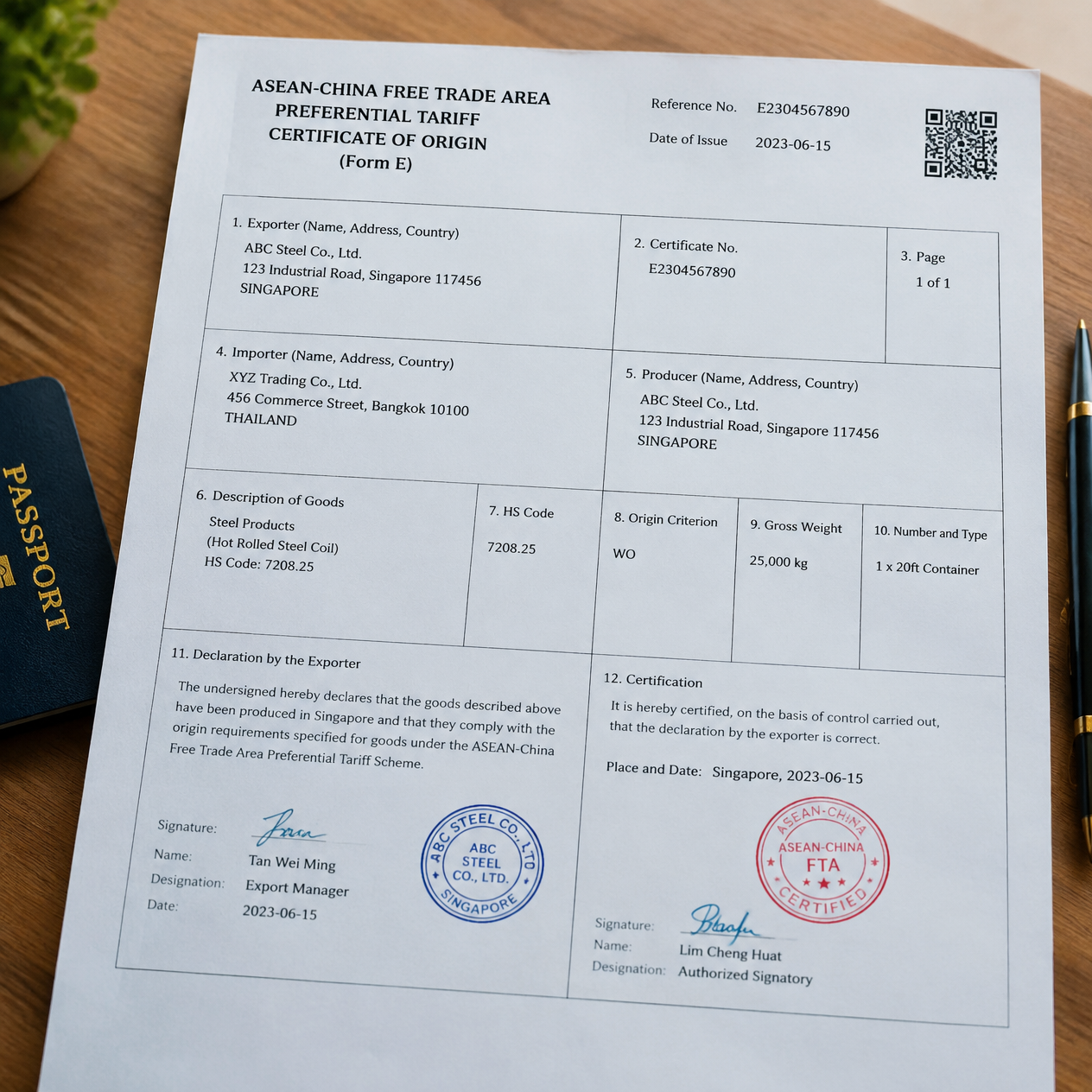
A certificate of origin steel import claim decides whether your HRC clears at 0% or at the full MFN rate. It is one sheet of paper, or one e-Form record.
I have watched containers and bulk parcels sit at Cigading, Tanjung Priok, Tanjung Perak and Merak over a single misplaced character. The steel was genuine and the origin was real. The paperwork didn’t match.
This guide covers how preferential origin works for steel, which forms matter, and where cargo gets rejected.
What a Preferential COO Does
A non-preferential COO only states where goods come from. A preferential COO claims a reduced duty under a free trade agreement (FTA).
For Indonesian steel importers, that means:
- Form D under ATIGA, for ASEAN-origin goods
- Form E under ACFTA, for Chinese-origin goods
- Form AK (Korea), Form AANZ (Australia and New Zealand), and the IJEPA certificate (Japan)
- RCEP origin documents, which can include approved-exporter declarations
The form only proves a claim. The goods themselves must satisfy the Rules of Origin (ROO).
Rules of Origin in Plain Terms
Two tests dominate steel.
Regional Value Content (RVC): a minimum share of the product’s value, commonly 40%, must originate within the FTA area.
Change in Tariff Classification (CTC): the inputs must change tariff heading (CTH) or chapter when processed into the final product.
Most agreements let the exporter choose either test. That matters for steel. A mill in Vietnam that rolls HRC from imported slab may fail RVC but pass CTC, because slab (HS 7207) becomes flat-rolled coil (HS 7208). A mill buying finished coil and only slitting it will not qualify.
Most mills qualify under CTC, not RVC. Rarely the other way round. So ask your supplier which test they claimed. Then ask how they’d prove it.
Certificate of Origin Steel Import: The Preferential COO Matrix
Rates move. Pull the live rate for your 8-digit HS line from the current BTKI before you lock in a price. Quote off an old number and your margin pays for it.
| Agreement & Form | Governing Origin Rule | Preferential vs. MFN (HS 7208/7209) | Electronic Exchange Status | Common Customs Rejection Pitfall |
|---|---|---|---|---|
| Form E (ACFTA, China) | RVC 40% or CTC; exporter’s choice | Usually 0% preferential, versus MFN that varies by sub-heading, from low single digits up to roughly 15% | e-Form E exchanged with China Customs via INSW since October 2020; hardcopy still circulates | Box 13 ticked wrongly (third-party invoicing, movement certificate); invoice number mismatch |
| Form D (ATIGA, ASEAN) | RVC 40% or CTC; cumulation within ASEAN | Usually 0%, versus the same MFN band | Mature e-Form D via ASEAN Single Window and INSW | Back-to-back COO missing; issue date after the shipment date without a retroactive tick |
| Form AK (AKFTA, Korea) | RVC 40% or CTC | Preferential rate depends on the tariff schedule; verify the line | Electronic exchange with Korea in place; check current status with your broker | Wrong HS code on certificate versus PIB |
| IJEPA certificate (Japan) | RVC 40% or CTC; product-specific rules for some lines | Preferential schedule varies by line; verify the line | Check current exchange status | Declared origin criterion inconsistent with the manufacturing story |
| Form AANZ (AANZFTA) | RVC 40% or CTC | Preferential rate varies; verify the line | Electronic exchange being rolled out, so confirm per supplier country | Missing certificate number on invoice |
| RCEP (incl. China, Korea, Japan, ASEAN) | RVC or CTC, with cumulation across members | Schedule varies by line and partner | Mix of CO and approved-exporter declarations | Declaration wording does not match the agreement’s requirement |
Two cautions apply to this table:
- Origin papers don’t touch anti-dumping or safeguard duties. If your HS line carries BMAD or BMTP, those still apply. The FTA rate only covers the ordinary import duty, nothing more.
- It does not clear Lartas either. The origin form is a tariff tool, not a permit. Importers who skip understanding Lartas import restrictions on steel cargo find that a perfect Form E still doesn’t release the shipment.
Step-by-Step Workflow
1. Pre-export origin certification
The exporter applies to the issuing authority before shipment. In China that is typically CCPIT or customs. In ASEAN it is the national trade ministry or equivalent.
- Mill test certificates and production records support the origin claim
- Application data must match the commercial invoice
- Apply before loading, not after
Scenario: A trader in Guangdong buys HRC from a mill, then applies for Form E using the trader’s invoice. The consignee on the Bill of Lading is a different entity. Third-party invoicing must be declared, or the claim fails.
2. Back-to-back COO through an intermediate port
Steel often moves through Singapore, Malaysia or Hong Kong before reaching Indonesia. Under ATIGA, an intermediate member can issue a back-to-back certificate based on the original.
- The original certificate must travel with the cargo trail
- The intermediate issuer must reference it
- Goods must stay under customs control during transit
Scenario: HRC leaves a Vietnamese mill, transships in Singapore and arrives at Tanjung Priok. The Singapore leg needs a back-to-back certificate. Without it, you have a Vietnamese Form D that customs cannot connect to the actual voyage.
3. INSW e-Form validation
Form D, and Form E out of China, travel as data too. The issuing country sends it across, and Indonesian customs pulls it up in INSW.
- Your PIB must reference the correct certificate number
- Data in the e-Form must match the PIB: HS code, quantity, weight, consignee, invoice number
- Hardcopy may be requested as a back-up
Scenario: The e-Form shows 24,980 MT. The Bill of Lading says 24,985 MT. Weight tolerances exist, but it can still trigger a query.
4. Customs audit and red-line clearance
If your shipment lands in the red lane, officers conduct a documentary and physical check. They compare:
- Certificate details against the PIB
- Certificate against the Bill of Lading and invoice
- Declared HS code against the certificate
- Origin story against the physical cargo and marking
A mismatch can end the preferential claim. You may then pay the MFN rate plus administrative penalties, depending on how the discrepancy is classified.
Where Cargo Gets Rejected
Talk to the clearance people at the big steel ports and you hear the same story. The origin criteria are rarely the problem. It’s the little stuff across the document set. A hyphen in a vessel name. Two digits swapped in an invoice number. A gross weight a few kilos off between the B/L and the form. Small things, same result: claim denied.
Most rejections come from clerical gaps, not fraud. But customs doesn’t have to guess the intent. It only needs the claim to fail the document check.
The usual culprits:
- Invoice number on the form differs from the actual invoice
- Vessel name or voyage differs from the B/L
- HS code on the form differs from the PIB
- Late issuance without the retroactive box ticked
- Certificate validity lapsed, since the usual window is 12 months
- Description of goods too generic to match the cargo
Practical Tactics to Protect Your 0%
Pre-check the draft. Get the draft COO from your supplier before they file anything. Then sit down with the draft invoice and the B/L instructions and compare them line by line. Boring work. It saves the whole claim.
Lock the shipping data first. Don’t let anyone finalize the COO until the B/L details, vessel and weights are firm. Move any of those afterwards and the certificate stops matching.
Confirm the HS code at 8 digits. Past 6 digits, the Chinese and Indonesian schedules go their own ways. Don’t assume they match. Agree the Indonesian code with your broker, and do it before the cargo sails.
Ask for the origin criterion. RVC percentage or CTC claim, whichever the exporter used. A supplier who can’t answer is a risk.
Verify the e-Form is actually transmitted. Ask your broker to check in INSW before the vessel arrives. Not after. After is too late.
Model both outcomes. Price the shipment at the preferential rate and at MFN. If the margin collapses at MFN, treat your COO risk as a cost line.
Retroactive Certificates and Corrections
Retroactive certificates are possible. Just not painless. Box 13 has to be ticked, and the issuing authority has to say yes. Expect closer review.
Fixing a hardcopy certificate usually isn’t a pen-and-initials job. The issuer has to authorize the correction, not the exporter. A replacement certificate has its own rules too, and it can land after the demurrage clock has already hurt you.
Stacking With Wider Compliance
Origin is one layer. Standards, import approvals, anti-dumping measures and port procedures run alongside it. For the broader picture, see our complete Indonesia steel import compliance guide.
I always tell importers to check origin eligibility in the contract stage. Writing “supplier to provide valid Form E/Form D, matching all shipping documents” into the purchase agreement costs nothing. Put a clause in the contract: if the certificate gets rejected over clerical errors, the supplier eats the duty difference. Plenty of mills will sign it once they see you know how this works.
Quick reminder: this is practical know-how, not legal advice. Rates, BTKI lines and procedures shift. Check current rules, or ask a licensed customs broker, before you ship.
About the Author: Ilham Sandri Koto