
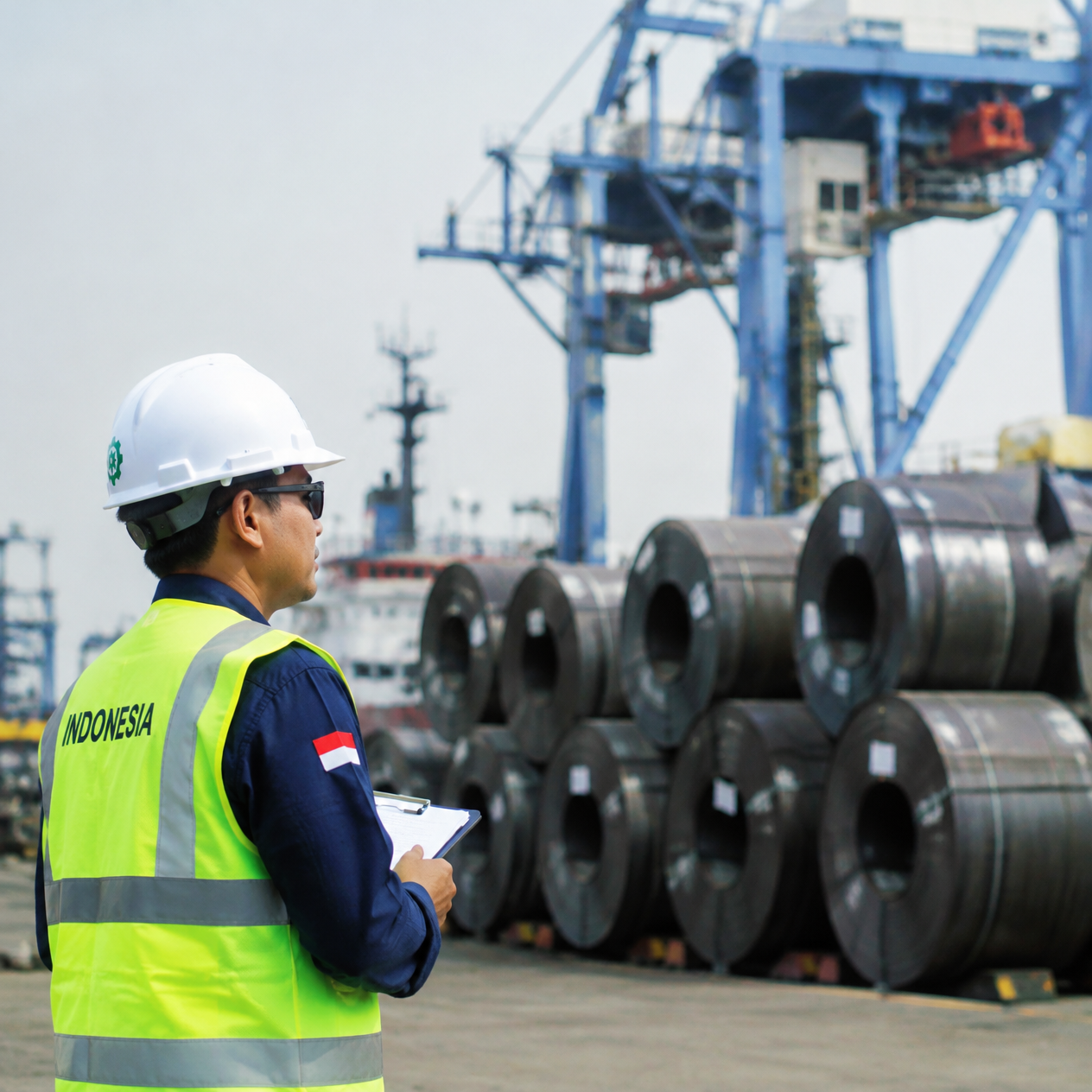
Indonesia steel import regulations don’t care about goodwill. Steel clears customs on paper, and the paper has to match.
I’ve stood on the quay at Cigading while a vessel of HRC sat idle because one digit on one document disagreed with another. At Merak and Tanjung Priok the story rarely changes. The cargo is fine. The mill certificate is fine. The documents don’t agree with each other.
So here’s how Indonesia steel import regulations actually play out at the port. No theory. Just what keeps your coils, wire rods, and structural sections from turning into very expensive storage.
Why Indonesia steel import regulations treat steel as restricted
Steel is a restricted import in Indonesia. So are alloy steel and the downstream products made from it. Under Permendag 22/2025, you need an Import Approval (PI) in hand before the cargo enters the Customs Territory. You also need a Surveyor Report (LS), which comes from a surveyor the Minister has appointed, once they’ve done the technical check.
Two ministries share the gatekeeping. The Ministry of Industry decides whether you get a technical recommendation. The Ministry of Trade decides whether you get the PI. Customs then checks that both match your declaration.
Steel import compliance Indonesia is therefore a chain, and each link depends on the one before it.
The compliance chain at a glance
Before the workflow, here is the full map. I use this table when onboarding new importers.
| Import Regulatory Requirement | Governing Authority & Portal | Mandatory Prerequisite Documents | Estimated Lead Time* | High-Risk Customs Bottleneck / Red-Line Trap |
|---|---|---|---|---|
| NIB + API-U or API-P (importer identity) | OSS/BKPM; recognized in INSW | Deed of establishment, NPWP, business activity codes (KBLI) matching steel trade or production | 1–3 days if KBLI is correct | KBLI doesn’t cover the HS lines you’re importing; application is blocked later |
| Pertek (technical recommendation, Permenperin 1/2024) | Ministry of Industry via SINSW/SIINas | Import plan (HS, description, quality standard), prior-year realization data, stamped statements; mill test certificates for alloy steel | 2–4 weeks | Import plan HS lines differ from what you later ship |
| Import Approval / PI (Permendag 16/2025 as amended, 22/2025) | Ministry of Trade via INATRADE/SINSW | Valid NIB/API, approved Pertek | 1–2 weeks | Volume, HS, or validity period doesn’t match the actual shipment |
| SNI Mandatory Marking | Ministry of Industry; surveyor checks conformity | Certified SNI product or a valid exemption basis (e.g., raw material for API-P) | Varies by product | Assuming “raw material” exempts you without the exemption paperwork |
| Surveyor Report / LS | Appointed surveyor (e.g., Sucofindo/Surveyor Indonesia KSO) | PI, commercial invoice, packing list, mill certificates, B/L | 3–7 working days after inspection | LS data (PI number, HS, quantity) disagrees with invoice or PI |
| PIB / INSW customs declaration | DG Customs & Excise via INSW | PI number, LS number, invoice, B/L, packing list | Same day to 3 days | Missing PI/LS reference; selectivity lane turns red |
| Realization reporting | Ministry of Trade (electronic) | Import realization data, LS upload | Ongoing, post-clearance | Skipping reports (even nil reports) triggers sanctions |
Those lead times are my own rules of thumb from past files. They’re not official service levels, so check with your licensing agent before you build a schedule on them.
Step 1: Get your importer status right
Start with NIB and API. General importers hold API-U. Manufacturers importing their own feedstock hold API-P.
Which one you are changes what the Ministry of Industry asks you for. A stockist and an ERW pipe mill? Totally different stories. The Pertek reflects that.
Callout: Check your KBLI codes first. If your business activity codes don’t describe steel trading or manufacturing, fix that before touching Pertek. I’ve watched weeks disappear here.
Step 2: Secure the Pertek
This is where most newcomers stall.
Under Permenperin 1/2024, anyone importing steel, whether API-U or API-P, must hold a PI, and the PI requires a Pertek issued by the Minister of Industry. The process runs through SINSW into the industry ministry’s system.
What you submit: an import plan stating HS code, goods description, and quality standard or technical specification, plus current-year realization data (PI and import notification numbers). Alloy steel importers add mill test certificates and stamped statements.
One more detail worth planning around: the Pertek is valid for one calendar year, and you can apply for next year’s during the current year. I tell clients to apply for next year’s Pertek well before December. January queues are painful.
Practical scenario: A trader plans 5,000 MT of HRC but lists only one HS line in the plan. Mid-year the mill offers a thicker gauge that falls under a different line. No Pertek amendment, no PI amendment, no shipment. Build the plan with room for realistic variations.
Step 3: Obtain the PI
With the Pertek in hand, you apply for the Import Approval through INATRADE and SINSW.
Treat the PI as the master reference. Its number flows into the LS and then into the PIB. If any downstream document drifts from the PI, you are the one explaining it to a customs officer.
Step 4: Pre-shipment verification and the LS
Here is where foreign mills need to pay attention.
The surveyor verifies the shipment against your PI and issues the Surveyor Report. Verification is done by surveyors appointed by the Minister. In practice, you coordinate inspection at the loading port, hand over the PI, invoice, packing list, and mill certificates, and wait for the LS.
Conformity with SNI is part of what gets checked for steel falling under mandatory standards. Don’t assume exemptions. Raw-material relief for API-P importers exists in the standards framework, but it is documented, not automatic.
The 2026 update you should know
Permendag 18/2026, issued June 2026, changed two things that matter directly to steel importers.
First, an LS can still be issued after the PI expires, provided verification was completed and the goods arrived before the PI’s expiry. The arrival date is proven through the BC 1.1 manifest.
Second, validation between the PI number inside the LS and the customs documents has been strengthened. Expect a tighter system match, not a friendlier officer.
Callout: Vessel delays and PI validity. If a vessel is running late, confirm arrival timing against PI expiry now, not at berthing. A manifest date after expiry removes the safety net.
Step 5: PIB filing through INSW
Now the declaration. Your PIB must carry the PI and LS references. Customs rejects declarations missing the PI or LS.
Check four things before submission:
- HS code identical on Pertek plan, PI, LS, invoice, and PIB
- Quantity and unit consistent (MT versus pieces on structural sections)
- Origin and description worded the same way everywhere
- PI number typed exactly as issued
What the red line really means
The customs selectivity system assigns lanes. A red lane triggers physical and document inspection.
Brokers across Cigading, Merak, and Tanjung Priok tend to agree on one point. Most red-line holds on steel come from document misalignment, not suspicion of the cargo. The classic case is an HS code on the Pertek and PI that doesn’t match the Commercial Invoice. The officer can’t reconcile them, the container or vessel sits, and port demurrage starts compounding by the day.
That cost belongs in your landed-cost model, not your surprise column. We cover the wider pattern in avoiding costly supply chain mistakes that drain operational margins.
Special routes: zones and exemptions
Some shipments skip the full chain. Goods going into a KPBPB, KEK, or bonded zone don’t need a PI or LS, and no port designation either. That lasts until they move out into the Customs Territory. Then the rules switch back on, minus the designated-port part.
Planning to park steel in a bonded zone and release it later? The release needs its own PI. Think about the exit paperwork, not just the entry.
After clearance: reporting
Clearance is not the finish line. Importers holding a PI must file electronic realization and distribution reports, including nil reports, and upload the LS. Permendag 18/2026 also adjusted sanctions for importers who skip realization reports, so treat this as a calendar item with an owner.
Missed reports can complicate your next Pertek and PI cycle. Quiet administrative neglect has a way of resurfacing at renewal.
Go paperless where you can
Mismatches multiply when documents are retyped between parties. Digital bills of lading and electronic documents reduce transcription errors, and our look at paperless trade and digital shipping documents explains how that shift is reshaping freight paperwork.
Common pitfalls I see repeatedly
- Starting at the PI. Pertek comes first, and it takes time.
- Treating the mill’s invoice as the source of truth. The PI is the source of truth. The invoice must conform to it.
- Ignoring PI validity against vessel schedules. One late berth can strand a shipment.
- Assuming SNI exemptions. Keep the supporting basis on file.
- Forgetting nil reports. They count.
A pre-shipment checklist for foreign mills
Ask your Indonesian buyer for these before you load:
- Valid PI number, HS lines, quantity, and expiry date
- Confirmation the Pertek covers the exact grade and gauge
- Surveyor appointment and inspection date at loading port
- Draft invoice and packing list pre-checked against the PI
- SNI status for each product line
Send drafts first. Correcting a draft costs minutes. Correcting an issued LS costs days.
Keeping up with Indonesia steel import regulations
Indonesian trade rules keep shifting, and the 2026 amendment points one way: tighter system checks. So before you commit to a shipment, confirm the current requirements with the Ministry of Trade, the Ministry of Industry, and your licensed customs broker. Want a second pair of eyes on your documents before the vessel sails? The Mahia Ekspres team can go through them with you.
About the Author: Ilham Sandri Koto